Runlayer Alternatives and Pricing: Metorial vs Runlayer
Metorial and Runlayer both sit between AI agents and the systems those agents are allowed to interact with, handling identity, access, and audit logging. Three differences decide most evaluations. Turning on Metorial is something one person can do this afternoon, using the company sign-in that already exists, while every path on Runlayer's site leads to booking a call with sales and its pricing isn't published. Metorial gives non-engineers a shared editor for skills, while Runlayer's skills are written in a code repository and published with a command-line tool. And Metorial's code is public, so a team can read how access decisions are made.
An MCP gateway sits between agents and the systems they're allowed to touch: who can connect, what they're allowed to call, and what gets logged when they do. Every vendor in this category promises identity, access, and an audit trail. What varies is what it takes to turn that on: whether a team can do it themselves this week, or whether the vendor's own core access feature needs weeks of conversations first.
Want to see Metorial with your own tools? Book a demo.
Why the setup step is the first real difference
A rollout that depends on a vendor's own staff to configure moves on the vendor's calendar, not yours. If turning on access control means booking a call, waiting for a callback, and scheduling an implementation window, that is weeks added to a project before a single agent is connected. That happens at a stage when you haven't even seen the product itself. On the other hand, a rollout a team configures itself, using the identity system it already runs on, jump starts the whole process and gives the team the immediate benefits of the product.
Can a team turn on agent access control itself, or does it need a sales call first?
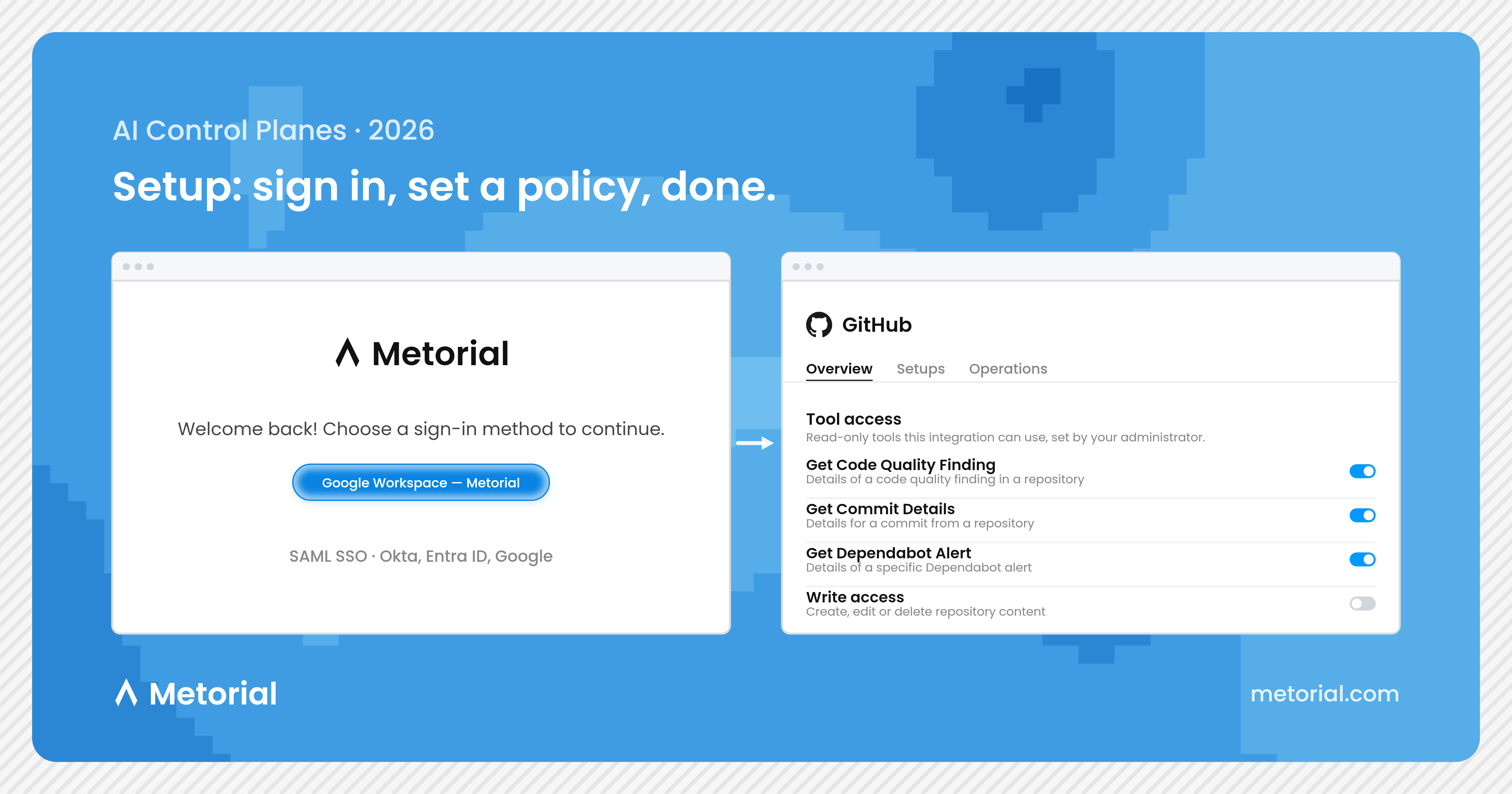
Metorial's access control starts with a company single sign-on (SSO) - the same login employees already use for email - connecting agents to real identity from the first step. From there, an administrator sets policy per user group, think sales, HR team or engineering. Then, they define what each agent can access, and that policy applies everywhere at once, across all of Metorial's products: Portals, Magic MCP, and the API. Connecting is pasting one URL into an AI client, something anyone on the team can do without help from IT.
Runlayer takes a different approach to identity. Its Agent Accounts give each agent its own identity in the workspace, with its own policies, tokens and audit trail, and people delegate their authority to it. In Metorial, an agent acts with the access of the person who uses it, through that person's own connected accounts, so it can never reach more than they can. Both approaches record who did what. Getting started is where they differ: Runlayer's site has no sign-up, and its only call to action is booking a demo.
Moonfire chose Metorial for exactly this requirement: actions needed to run as the user, so every read and write could be traced to the person who started it.

Who can write and share skills?
A skill is a written playbook an AI follows, such as how a team closes the month or writes a renewal email. The people who know those processes best are often not engineers.
Metorial's skills editor works like a shared document. Finance or sales can write and edit a skill without a GitHub account, and it syncs to GitHub and out to Claude, ChatGPT and Cursor.
Runlayer's skills are directories with a SKILL.md file, written in a code repository and published to Runlayer with its command-line tool, typically from a CI pipeline. Teammates then install them into Claude Code, Cursor and other clients. That suits engineering teams, and it means anyone outside engineering needs an engineer to change a skill.
Is the code handling that access something you can inspect yourself?
Metorial's core is open source, split across two public repositories under two licenses, Apache 2.0 for the integration catalog and FSL-1.1 (Functional Source License 1.1) for the engine, with over 3,900 stars in total across its public repos.
Runlayer's GitHub organization lists exactly two public repositories: a plugin marketplace and a fork of Okta's own MCP server with version pinning. Neither is the access platform itself. A team evaluating Runlayer can't read the code making its access decisions the way it can with Metorial's.
What does it cost, and can you find out without a phone call?
Metorial publishes its pricing. The free Dev plan covers up to 500,000 tool calls a month and two workforce seats. The Scale plan is $250 a month, includes 20 seats with an additional flat seat-based pricing rate and covers 2.5 million tool calls a month. Enterprise pricing is scoped with sales.
Runlayer doesn't publish pricing. Its pricing page no longer loads, and the only call to action on its homepage is booking a demo. A team can't compare the two vendors' costs, or find out whether Runlayer has a plan for a smaller team, without first getting on a call with Runlayer.
Crunched made the build-or-buy call on the same basis: it wanted its engineers on its own product, not on maintaining connectors.

Where the two overlap
| Metorial | Runlayer | |
|---|---|---|
| Single sign-on | Yes | Yes |
| Role-based permissions | Yes, per user and group | Yes, per user, group, role or agent account |
| Audit logging | Yes | Yes |
| SOC 2 | Yes | Yes |
| Skills editor for non-engineers | Yes | No, skills are published from a repository with a CLI |
| Self-serve sign-up | Yes | No |
| Published pricing | Yes, up to Enterprise | No |
| Public source code | Yes, integrations (Apache 2.0) and engine (FSL) | No |
Both hold SOC 2, both offer single sign-on, both describe role-based permissions and audit logging as part of the product. And on its own, none of that is a reason to pick either one over the other. It's the baseline a serious governance product is expected to clear. What differs is everything else on this page.
What else does Runlayer cover?
Runlayer's pages list four things beyond the gateway. Shadow detection finds unmanaged MCP servers, skills, plugins and client configurations on managed devices through existing device management. Policies grant access by user, group, role or agent account, down to individual tools, and can test tool arguments, IP ranges, OAuth scopes, tool annotations and session history at call time. Runtime security scans requests and outputs. Identity integrates through SSO and SCIM.
Its connectors are managed MCP servers with authentication, permissions and client setup packaged together, and any MCP endpoint can be added manually. Deployment is Runlayer-hosted, a single-tenant AWS deployment that Runlayer manages, or self-hosted on AWS with ECS and Terraform or on Kubernetes through EKS or GKE.
Device-level discovery is the clearest gap on Metorial's side: Metorial governs the tools you approve, and it does not scan employee devices for unapproved ones.
Other Runlayer alternatives
Arcade: authorization at call time
Arcade says agents act on behalf of authenticated users rather than through service accounts, and lists SOC 2 compliance, SSO, role-based access control and audit logs. Pricing is published: the free plan includes 2,000 auth events and 2,000 tool calls a month, and Team is $25 a month plus $0.10 per auth event and $0.01 per tool call. Team runs on Arcade Cloud only, with VPC or air-gapped deployment on Enterprise. See Metorial vs Arcade.dev.
Barndoor: spend and data protection
Barndoor places a gateway between teams and both models and MCP servers. It lists per-tool permissions, real-time spend tracking by user, team and model, data loss prevention, SOC 2 Type II, and deployment as SaaS, private cloud or on-premises. Its pages don't state pricing.
Mintive (formerly MintMCP): role-scoped hosted endpoints
Mintive lists role-based access to tools, audit trails of every tool interaction, OAuth and SSO, PII detection and secret scanning, an agent monitor, and SOC 2 Type II. Its pages describe a hosted service and don't detail self-hosting or published pricing.
Obot: open-source governance
Obot, under the MIT license, provides an MCP gateway, an LLM gateway, MCP and skills registries, sandboxed servers on Docker or Kubernetes, identity-based permissions and correlated audit logs. You run and upgrade it yourself.
Cloudflare MCP server portals
Portals aggregate MCP servers behind Cloudflare Access policies, with tool allowlists, tool aliases and per-user request logs. A portal supports up to 80 servers and no stdio-only servers, and it needs a Cloudflare One subscription and a configured identity provider.
Who should pick whom?
For a company between 50 and 1,000 employees that wants to turn on agent access control today without scheduling a vendor call, Metorial is the clear pick. Setup starts with a sign-in a team already has, people outside engineering can write and share skills, the code behind it is public under two named licenses, and the pricing is a page, not a form. If your requirements are less clear and your timeline is more than a quarter, a strong implementation partner can matter, so Runlayer becomes an alternate choice.
Stay with Runlayer if device-level discovery and call-time conditions on arguments and network context drive the decision. Pick Arcade for per-user authorization with a published price, Barndoor for spend tracking, Obot if you want to operate open source yourself, and Cloudflare if employees already sit behind Cloudflare Access.
Want to see how it fits your own stack? Book a demo. For a wider view, see the full five-way comparison of enterprise AI gateways or the head-to-head with Arcade.dev.
FAQ
Can a team set up Metorial's access control without contacting Metorial first?
Yes. Signing in happens through a company's existing SSO, and an administrator sets access policy from there, with no approval step or sales call required.
Does Runlayer have pricing for smaller businesses?
Runlayer doesn't publish any pricing, so the only way to find out is a call with its sales team. Metorial has a free Dev plan and a Scale plan at $250 a month that a team can start on its own.
Can people outside engineering edit skills in Runlayer?
Not directly. Runlayer's skills are written in a code repository and published with its command-line tool. In Metorial, anyone with access can edit a skill in a shared editor, without a GitHub account.
How do Runlayer's Agent Accounts compare to Metorial's approach?
Runlayer's Agent Accounts give each agent its own identity, and people delegate their authority to it. In Metorial, an agent acts with the access of the person using it, through their own connected accounts. Both record which person and agent were behind each action.
Is Runlayer's core platform open source?
No. Runlayer's access platform itself isn't in a public repository.
Can Runlayer be self-hosted?
Yes. Runlayer documents a hosted option, a single-tenant deployment on AWS that Runlayer manages, and self-hosting in your own AWS account with ECS and Terraform, or on Kubernetes through EKS or GKE.
Which Runlayer alternative is open source?
Obot is MIT licensed and runs on Docker or Kubernetes. Microsoft MCP Gateway (MIT) and IBM ContextForge (Apache 2.0) are open-source gateways without the broader governance platform. Metorial's engine is source-available under FSL and its integration catalog is Apache 2.0, and it can be self-hosted.
Do I need runtime scanning of tool calls?
It depends on the risk you are managing. Permission limits cap what an agent can reach, and scanning inspects what it sends and receives within that limit. Teams handling regulated data tend to want both, while a small read-only rollout may not.
Where can a team see Runlayer's pricing without booking a demo?
Nowhere found on runlayer.com as of 18 November 2026. The pricing page no longer loads, and the only call to action on the homepage is booking a demo.
Sources
- Runlayer homepage (checked 2026-08-04): runlayer.com
- Runlayer identity policy page (checked 2026-08-04): runlayer.com/identity-policy
- Runlayer pricing page (checked 2026-08-04): runlayer.com/pricing
- Runlayer GitHub organization (checked 2026-08-04): github.com/runlayer
- Metorial pricing page (checked 2026-08-04): metorial.com/pricing
- Metorial access control page (checked 2026-08-04): metorial.com/access-control
- Metorial Magic MCP page (checked 2026-08-04): metorial.com/magic-mcp
- Metorial integration catalog repository (checked 2026-08-04): github.com/metorial/metorial
- Metorial platform engine repository (checked 2026-08-04): github.com/metorial/metorial-platform
- Metorial MCP server index (checked 2026-08-04): github.com/metorial/mcp-index
- Runlayer docs, deployment overview (checked 2026-10-04): docs.runlayer.com/deployment/overview
- Runlayer docs, policies (checked 2026-10-04): docs.runlayer.com/platform-policies
- Arcade pricing (checked 2026-10-04): arcade.dev/pricing
- Runlayer docs, skills (checked 2026-11-18): docs.runlayer.com/platform-skills
- Runlayer docs, agent accounts (checked 2026-11-18): docs.runlayer.com/platform-agent-accounts
- Runlayer homepage and pricing page (rechecked 2026-11-18): runlayer.com
- Metorial customer stories: Moonfire and Crunched